Sunday, September 7, 2008

Our Biology Pioneers

The students in year 12 science are our first batch that will sit the final examinations in the subject. In the Rajasthan Education system students who study Science must study Chemistry and Physics and then choose for their third subject either Mathematics or Biology.
These photos are of our biology students. The girl in the middle of the second photo is a most brilliant student who has won several scholarships from the Government due to her results in the last two years.
What amazes me about these students is their focus on their studies. For the whole of 11th and 12th class our science students have been studying day and night. We constantly have to go to the hostel in the evenings and explain to them that there is a long way to go and that they need to keep a balance and get some sleep as well. This is their chance to take a step in life, the students largely being first generation learners, and perhaps because of that they appreciate even more the chance that lies before them.

Posted by Picasa

Computer classes

Our computer lab is one of the busiest parts of the school/college with students continuously in the class from 830am until 530pm. The computer teacher is absolutely run off his feet but he is still loving it.
Thanks to the people of Bremmer Tafe in Queensland and the Ipswich Multi Cultural Society who together are arranging for the supply of 10 computers for the school which will come in October, the first one having arrived last month.
By next year we hope to open a second computer lab in the school so that students can have more lab time. If you are upgrading your computer or your laptop keep in mind that there may be a happy home for your old computer in our school!! Anyone who wishes to help with this please contact my email.

Also thanks to the Yoga In Daily Life Ashram in Queensland who have upgraded their multimedia projector and made sure that our school got the old one. It is awesome and opens a new dimension of teaching which hasn't been seen in this area before.

Posted by Picasa

View of the school from the mountain


These photos of the school are taken from "the mountain". For those not familiar with the Ashram in Jadan one of the projects already undertaken was a rainwater harvesting project in which a dam 120m x 140m x 10 m deep was constructed in the Ashram for the purposes of catching rainwater. The earth and rock that was excavated from the dam was used to make a mountain of 45 metres height in the south west corner of the Ashram. Swamiji Maharaj's idea of making a mountain was practical as well as beautiful. It saved money on diesel which would have been used transporting the earth out of the Ashram, the mountain is a place of beauty and has become a tourist attraction in it's own right and according to the ancient science of Vastu Shastra the highest and heaviest point in a property should be in the South West corner.
The future construction of the school and college which is now starting will make the present building into a quadrangular shape extending the two sides forward and then joining across the front of the school. After that is completed a seperate college building will be constructed to the left of the school as you look in the photos.
In the distance of the top photo you can see Shree Paramhans Swami Madhavanand Hospital, built by Swamiji Maharaj and the "Austrian Hospital in India" Society from Vienna Austria. It is a beautiful building which will house a 90 bed allopathic hospital for the people of the local area. At present the building work is complete and the work of furnishing and equiping the hospital is underway so that the hospital can start in the next months.
Posted by Picasa

Morning prayers


Full house for morning prayers and assembly. When the students are singing their morning prayers and national anthem in the morning the sound goes through the whole Ashram, reaching more than 2 km away. It is a really special part of the morning.

Posted by Picasa

School scenes August 2008


Classes are on and concentration is high.

Some first class students were also lucky enough to have Swamiji teach them for a short while.
Posted by Picasa

The fleet

To everyone who helped, once again thanks. This is our fleet outside the school building. Hopefully for next year we can add one or two buses more to the photo.
Posted by Picasa

Update from August and September

It has been an interesting month in school. A lot of new students settling in and learning to work together. This week the district sports tournaments are on and a lot of students are away competing. They are competing in the badminton, tennis, cricket, handball and judo tournaments.

In Judo 9 of the girls and 4 of the boys won their divisions. The girls u/17 tennis team is in the finals today and the u/19s lost in the semis. The boys came third in the handball and in the senior cricket, the juniors are yet to play.

On the 4th of September the ground breaking ceremony was done for extensions of the school and college building. There will be construction of 30 more rooms which will then cover the needs of the school way into the future. At present the situation in the building that we have, which seemed soooooo big just 8 months ago, is really really really tight.

The real news of the last month is that broad band reached to our village! So now i hope that in the future we can get some more interesting photos and items onto this webpage for everybody to enjoy.

Sunday, July 6, 2008

New school year, new buses, new students

Hari Om and welcome to the new school year!!!

It has been a most intense fortnight here in Jadan. We have been taking admissions for school and college which both started on 01st July. There has also been a huge increase in the number of students in our hostel for this session.

The number of students has crossed 900. On top of that there have been more than 500 families come with hope and expectation to which we have had to say sorry, the school is full. Till date they are still coming.

This year with Swamiji Maharaj’s blessing we also started College courses in Bachelor of Arts and the response was beyond expectation. 30 students have enrolled in the course. The students are from the villages and are mainly those that wouldn’t have gone to a regular college but would have studied by correspondence. There has been a special interest from parents who wouldn’t send their girls to a government college because of security issues. It is gratifying to see them happily send their children to the college in the Ashram.

We ended up purchasing the third bus in early June. After much deliberation the decision was taken to get a new bus rather than second hand. Although it proved much more expensive the decisive issue was fuel consumption, which is nearly half in the new bus. Considering the environment and the cost of diesel it seemed a prudent option. Of course, as is the norm in Indian culture, there were many issues with getting the bus here on time etc and in the end the bus was delivered in the Ashram at 3am on the 1st of July. After a quick sleep the driver set off at 0630am to pick the students up for school!!!!!!!!!!!!!

So we have set off into the new school year with 900 students, 26
classes, 5 buses and 109 boys staying here in the ashram in our hostel. Full house!!

Thanks to everyone who joined us in reaching this point and enjoy being with us for the year ahead.

Friday, April 25, 2008

News and new admissions

It is new year in the education world here. Lots of people coming for admissions, enquiries, interviews for new staff. It seems that there will easily be 900 in the school come the 01st of July.

The 8th class students had a great result. One of the boys came 15th in the district (out of 32000 who sat the exam) and one of the girls came 44th in the district. It sent the whole of Pali into confusion as to how a school of village students can produce such good results (there is a mindset that city children are more intelligent). It is great to see the fruits of the teacher’s labor come so quickly.

For those who are part of the journey on the bus thought you might like to know the current position. Up till now donations for the buses amount to 1, 713, 962 rupees!!!! At the average rate of the dollar during the period that people have been giving (say 34 rupees) it comes to 50, 410 Australian dollars!! Fantastic, unbelievable, how can one express enough thanks for all the support??

We have utilized that money so far as follows:

    • 566, 000 went on the purchase and repairing (to get it on the road) of the first bus which we took last year after starting the fundraising.
    • 395000 was spent buying the second bus and by the time it is ready (it is under full repairing where we stripped it back to the frame to remove rust, put insulation in the roof and sides to protect from the heat, new wiring, seating, painting, tires etc etc) we plan that it will cost a total of 500000 rupees ( that’s about 14000 aud). ( there is a photo attached of the bus at it’s most naked point)

That leaves us with nearly 650, 000 rupees left.

At present we are looking for one more big bus. If we manage to get it on road for less than 500, 000 then I plan to look for one more small bus with the rest of the funds. I hope to find one for 200-250000 (there will still be a few seats left if someone can help out to reach that target). Then we are really in position to pick up all of the students and get them home without too much waiting.

It is quite complicated to fit in all of the villages (now we have 14) and also to deal with extra villages which are constantly requesting that they also be included on the bus routes (Last night I was invited to one village where the whole village turned up to convince us that their children should also be allowed to come).

Anyhow, I have to go. Tonight we have a meeting with the parents in one of the bigger villages on our route. They have arranged the whole meeting area and all parents are coming. It is impossible to describe just how unique that is in our area where parents normally try to avoid thinking that education is anything other than the schools responsibility.

Enjoy and please keep checking the site as we try and make it a little more interesting.

Ps: Last night we had the meeting and the highlight was one parent who was all teary eyed in gratitude. His daughter had just done the eighth class exams having joined the school this year. When she joined he was quite sure that she wouldn’t pass 8th class as she had only just scraped through seventh. She passed, actually she scored 76% which is more than double the pass mark of 36% and a super mark by any standards. Now she is starting to dream of going beyond 12th and even to college – in the college which is also starting in the Ashram this year!! You have to love it when things like that happen.

Enjoy!!

Swami Jasraj Puri

Posted by Picasa

Tuesday, April 15, 2008

Results of the exams for 8th class for 2007-08

Yesterday they released the results of the Year 8 Government examination which are conducted at the district level. All of the students passed well with our best students coming 15th and 46th in the whole district. It is a fantastic effort considering that more than 32000 students sat the examination!! The students are feeling quite proud of themselves today and rightly so.

The other students also did really well. From 24 students 15 of them got 70% or above and only one student scored below 60%. The pass mark here in exams is 38% so there wasn't anyone coming close to failing.

Tuesday, March 25, 2008

Colours of Holi


Holi is the festival of colours. Most of the students had gone for holidays but those who stayed had a lot of fun. putting colour on whoever they could find. In the picture they have just got their mathematics teacher after a lot of chasing him around. You can see in the fourth photo that they got me too.


Holi

India is a land of fairs and festivals. The Hindus, the Muslims and the Christians have their own festivals. The Holi is an important festival of Hindus. It is a festival of joy and happiness.

It is celebrated every year in the month of March in the spring season. In India spring is the best of all seasons of the year.

The festival of Holi is celebrated in the memory of devotee Prahlad, who had great faith in God. Hiranyakashyap, who was the king and also Prahlad’s father, tortured him but he did not give up his faith in God. Hiranyakashyap’s ego had become so big that he thought that only he himself should be worshipped. Hiranyakashyap asked his sister, Holika, who possessed a shawl that protected her from fire to sit in a burning fire with Prahlad in arms. As they sat in the flames wind swept away the shawl and Holika was burnt to ashes but Prahlad remained untouched by the flames.

On the day of Holi a bonfire is burnt representing the burning of Holi and Prahlad, who is represented by a coconut is pulled out of the flames unscathed. Men, women and children sing folk songs. They sprinkle coloured water and coloured powder on each other. Even the old people enjoy this festival of colour.

This festival removes social inequality. The rich and the poor, the high and the low, the weak and the strong enjoy this festival together. It creates the feelings of friendliness and mutual relationship among the people and celebrates the victory of humbleness and devotion over rampant ego.

Dinesh Tiwari, class 8th


Posted by Picasa

Wednesday, March 19, 2008

The New Science Laboratories

A view of our new Science Laboratories. A wonderful facillity.


Posted by Picasa

Wednesday, December 19, 2007

Saturday, December 15, 2007

Beautiful morning in Rajasthan

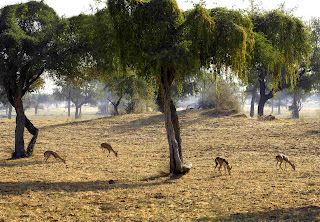
Some of the local wildlife. Special to watch especially early in the morning. This is about 20km from our ashram. One of the boys from school has put together some history about the blackbuck pictured and the trees which are in the scenes. Environmentalists from a different era with a tradition that continues.
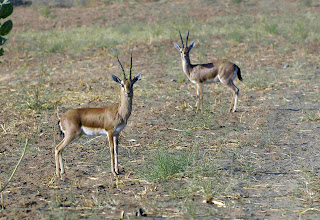
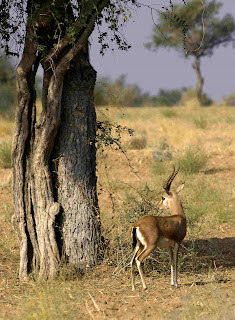
In the year 1451 AD during the reign of Rao Jodhaji, one of the bravest of the Rathore kings, an extraordinary child was born in the village of Pipasar. His father was the headman Thakur Lohat and his mother was Hamsadevi. The boy was called Jambaji. As a little boy, he was given the task of looking after his father’s large herd of cattle and sheep. It was great fun to take the animals out grazing, lie in the shade of blackbuck. Jambaji was fascinated by the lithe grace of this handsome antelope, and tought seat there was no sight more enthralling than a fight between two well- grown stags.

When Jambaji twenty-five years old, a great disaster overtook the whole region. The small quantity of rain that used to come regularly ceased altogether. The worst sufferers were the cattle. In the first year of drought, they could eat the bajra straw scored in the houses. The second year was very bad. There was not a blade of grass left standing any where. People hacked at any trees they could find and fed the animals on the leaves, but even so there was not enough browse for all the hungry animals. And the drought continued for eight consecutive years.

The people had hacked and hacked the last bit of foliage from all the trees, which finally began to dry up. When the stored grain was exhausted people ate khejdi pods and the flour of dried ber seeds. When this too was exhausted, they tore the bark off the sangri trees and powdered and cooked it. They hunted every one of the starving blackbucks, and finally they abandoned all hope and migrated in masses. Tens of thousands of cattle perished on the way. By now the whole country was barren. There was not a tree in sight for miles together, nor a single cow, or a blackbuck. The only people to hold on were big landlords like Jambaji’s father with huge stores of bajra that somehow lasted through the difficult times.

Jambaji was much affected by this drought. Many were the nights he spent in wakefulness because of the suffering he saw around him. The dying cattle, the starving children : they haunted him day and night. And finally, at the age of thirty-four, he had a vision. He saw man intoxicated with his own power, destroying the world around him. And he decided to change it all. If life was to flourish again in this desolate land, Jambaji saw that man would have to live in a different way, and according to different tenets and beliefs. Jambaji wanted the earth to be covered once again by an abundance of khejdi, ber, ker and sangria trees, he wanted herds of blackbuck to frolic again, and he wanted men to work for this. Jambaji knew the way to achieve this, and he began to broadcast his message in the year 1485.

His message included twenty nine basic tenets. Its two major commandments were a prohibition against the cutting down of any green tree or the killing of the animal, Jambaji’s message of humanity and respect for all living things was eagerly accepted. His teachings prompted the inhabitants of hundreds of hundreds of villages to reclothe the earth with its green cover.

Jambaji’s followers were called Bishnois or twenty-niners (bis= twenty, nou= nine) because they adhered to Jambaji’s twenty-nine precepts. They preserved the trees around their villages and protected blackbuck, chinkaras, peafowl and all other birds and animals. Gradually their territory became covered by trees, their cattle had abundant browse, their land recovered its fertility and the Bishnois became a prosperous people.

But out side their territory, all continue as before. The land was still being stripped of its green cover and the desert was spreading. The ninth descendant of Jambaji’s contemporary Rao Jodhaji now occupied the throne of Jodhpur.

Two and a half centuries have passed since this episode. Bishnois have now been guarding the trees, giving succour to the wild animals of Rajasthan, Haryana and Madhya Pradesh for nearly five centuries. Everywhere else, green cover of the Indian subcontinent has been ravaged and continues to be destroyed at an ever accelerating pace. The thousands upon thousands of blackbuck that coce roamed the Indian plains have all vanished without a trace. But near the few Bishnoi village the greenery not only persist, but also is ever on the increase and around their villages the blackbuck roam as freely as in Kalidasa’s time near the ashram of sage Kanva. Akbar was so amazed to see these herds of fearless blackbuck near Bishnoi temples that he personally recorded his wonder at witnessing a scene from satyayuga, the age of truth, in this kaliyuga, the corrupt present.

The sight is even more astonishing for us today than it was for the emperor Akbar four centuries ago, for the Bishnois continue to hold on to their magnificent obsession to this day.

Researched by Dinesh Tiwari, 8th class

Posted by Picasa